Selling a van presents a clear choice for many owners: hold out for the best private-sale price or choose a faster, lower-effort route with an instant buyer. This guide explains both approaches in practical terms so you can choose a fast, safe and financially sensible way to sell a van in the UK.
You will learn how private sales work, what instant van buyers do, the real trade-offs between price and speed, and condition-specific recommendations for damaged, MOT-failure and non-runner vans.
The article also compares paperwork, payment timing and collection logistics, and highlights key 2024 market trends that influence overall value. Read on for step-by-step guidance, quick-reference tables and actionable checklists so you can decide whether to sell privately or request an instant quote and move on quickly.
What Are the Main Differences Between Private Van Sales and Instant Van Buyers?

Private van sales are a seller-led route where you advertise the vehicle, manage viewings, negotiate price and complete transfer details; this method can deliver higher headline prices but requires more time and effort.
Instant van buyers operate as a service: they provide an instant quote from online valuation inputs, arrange collection and pay on or before collection, prioritising speed and certainty over maximum resale value.
The core difference is a trade-off between price potential and speed of completion, with private sales offering more upside for well-presented, in-demand vans and instant buyers offering faster sales with less hassle. Understanding that trade-off helps you select the right channel for your priorities and your vehicle’s condition.
How Private Van Sales Work in the UK
A private sale begins with preparing an advert and setting a realistic asking price based on comparable listings; this often includes paying for ad slots and organising paperwork such as the V5C and service history.
Sellers manage enquiries, arrange viewings and test drives, negotiate with prospective buyers, and agree payment methods, which can be time-consuming and expose them to no-shows or low offers.
Typical time-to-sell varies widely by model and condition, from days for high-demand vans to weeks or months for niche or high-mileage examples, and ad fees plus any pre-sale repairs reduce net proceeds. Good practice includes meeting buyers in safe, public locations, verifying I,D and using secure bank transfers; these responsibilities highlight how private sales differ from instant buyer convenience.
Understanding how instant van buyer services work explains why many sellers choose speed and certainty over chasing the very last pound of price.
How Instant Van Buyer Services Work
An instant van buyer is a service that gives an online valuation based on make, model, mileage and reported condition, followed by a firm offer and arranged collection; the process is designed to be fast and low-effort for the seller.
Valuations use market comparables and condition adjustments, so quoted prices reflect convenience, collection costs and the buyer’s margin for refurbishment or recycling.
Sellers usually provide basic vehicle details and photos, accept a firm offer, then agree to a collection window when the buyer collects the van and pays immediately or by direct bank transfer on collection.
The primary benefits are rapid completion, reduced admin and certainty of payment, which is often attractive for damaged or non-runner vans where private buyers are scarce. To decide quickly between routes, you need to weigh the advantages and drawbacks of selling privately.
What Are the Advantages and Disadvantages of Private Van Sales?
Private van sales can deliver stronger headline prices for well-maintained, popular vans, giving sellers control over timing and buyer selection. However, this route demands substantial time investment for advertising, arranging viewings and handling negotiations, while exposing sellers to safety and fraud risks unless they follow secure payment and meeting practices.
Costs such as advertising fees, optional repairs to achieve higher offers and the opportunity cost of keeping the van reduce net benefit for owners who value speed. Overall, private sales work best when you can afford to wait for the right buyer and when the vehicle’s condition or demand profile makes a higher price likely.
- Higher potential sale price: Sellers can often achieve a premium for well-presented, in-demand vans compared with instant buyer offers.
- Full control over sale terms: You choose viewing times, negotiate directly and agree cash or bank transfer arrangements that suit you.
- Selective buyer choice: You can screen prospective buyers for reliability and suitability, giving you more confidence in the sale.
These benefits must be balanced against predictable downsides.
- Time and effort: Advertising, responding to enquiries and arranging viewings require significant time and coordination.
- Safety and fraud risk: Handling private buyers increases exposure to scams and unsafe meeting scenarios if precautions are not taken.
- Hidden costs: Pre-sale repairs, MOT work, advertising and time with the vehicle off the road all reduce net proceeds.
| Private Sale Component | Attribute | Impact / Example |
|---|---|---|
| Advertising | Cost and reach | Paid adverts increase visibility but add fees and create extra work managing responses. |
| Viewings & Test Drives | Time and safety | Multiple viewings take time and require secure meeting practices. |
| Negotiation | Price variability | Buyers often negotiate down from the asking price, affecting final net value. |
| Pre-sale repairs | Upfront expense | Repairing minor faults can increase the sale price but may not fully recoup the cost. |
Examining these trade-offs shows why some sellers prioritise speed and certainty over chasing the last pound with a private sale, and why instant buyers can be a compelling alternative.
Benefits of Selling Your Van Privately
Selling privately offers the potential to capture the highest market price when supply is tight and demand for your van’s specification is strong. Sellers who invest in presentation, thorough cleaning, updated service records and minor cosmetic repairs, often attract better offers and faster interest from buyers seeking value.
You keep full control over payment method and timing, which can be valuable if you need to coordinate trade-ins or purchase replacements. When time is not critical and the van is in good condition, a private sale can maximize returns if you are prepared to manage the process.
Risks and Challenges of Private Van Sales
Private sales expose sellers to delays, low offers, no-shows and the administrative burden of transferring ownership and handling secure payment, all of which can erode the apparent advantage of a higher asking price.
Safety is a practical concern: meeting strangers at your property or allowing test drives increases risk unless you implement secure meeting procedures and ID checks.
There is also a realistic possibility that pre-sale repairs and time spent running ads will reduce the net gain compared with accepting a fast, guaranteed offer from an instant buyer. Mitigating these risks requires clear processes: meet in public places, insist on verified bank transfers and keep records of all communications.
| Private Sale Risk | Attribute | Mitigation / Example |
|---|---|---|
| Fraud | Payment security | Use confirmed bank transfers and avoid cash-only scenarios. |
| Delays | Time to sale | Price competitively and update adverts regularly to attract buyers. |
| Repair costs | Hidden expenses | Weigh the repair cost against the expected uplift in private sale price. |
With private sale pros and cons established, the next step is to look at instant buyers and how they serve sellers who need speed.
Why Choose Instant Van Buyers Like Cash Your Vans to Sell Your Van Fast?
Instant van buyers specialise in speed, certainty and low seller effort: their model centres on an instant online valuation, arranged collection and payment on collection, which removes advertising, viewings and negotiation from the seller’s workload.
For sellers prioritising convenience or dealing with vans in poor condition, instant buyers provide a predictable outcome and immediate cash flow, often with nationwide collection and no hidden fees. If you need to sell your van quickly or cannot invest time in repairs or marketing, an instant buyer reduces risk and administrative burden while providing a clear, firm offer.
Most instant buyers use a simple three-step process optimised for fast transactions.
- Get an Instant Quote: Enter basic vehicle details for an immediate online valuation.
- Free Collection: Agree on a collection window, and the buyer collects the vehicle at no extra charge.
- Get Paid on the Spot: Receive instant cash payment or a direct bank transfer at collection.
These steps illustrate why instant buyers can complete sales faster than private routes and why many sellers with urgent needs prefer this method.
How Cash Your Vans Makes Selling Fast and Hassle-Free
Cash Your Vans buys vans and offers an instant vehicle-buying service with a clear three-step process: Get an Instant Quote, Free Collection, and Get Paid on the Spot. The service delivers a fast, easy, nationwide approach with no hidden fees, and payment on collection via instant cash payment or direct bank transfer is part of the offering.
They accept vehicles in any condition, including MOT failures, vehicles with body damage, and non-runners, and provide free valuation and free collection so sellers face minimal logistical burden. For sellers who value speed and certainty, this model reduces the time from decision to completion and removes the need for advertising and multiple viewings.
Van Conditions Instant Buyers Accept
Yes, instant buyers typically accept vans in a wide range of conditions, and Cash Your Vans explicitly accepts vehicles with MOT failures, body damage and non-runners, which removes the need for sellers to undertake costly repairs before selling.
Valuations for damaged or non-running vans are adjusted to reflect repair, towing and refurbishment costs, so offers are lower than for good-condition vans but still provide a quick route to cash where private buyers may be scarce.
Collection logistics for non-runners are arranged by the buyer, avoiding towing costs for the seller, and paperwork is usually handled by the buyer to simplify transfer. If you have a problematic van and need speed, instant buyers reduce the time and effort required to dispose of the vehicle.
How Do Private Sales Compare to Instant Van Buyers in Terms of Price, Speed, and Convenience?
Private sales can yield higher gross sale prices for desirable, well-maintained vans, but selling privately usually takes longer and requires more seller effort and cost for advertising and repairs.
Instant van buyers prioritise speed and minimise seller tasks, offering immediate payment on collection and free nationwide collection, but their offers typically reflect convenience discounts and refurbishment margins.
Payment methods also differ: private buyers may offer cash or bank transfer negotiated at sale, while instant buyers generally provide direct bank transfer or instant cash payment at collection, helping guarantee funds and reduce fraud risk. Ultimately, the right route depends on whether you prioritise maximum sale price or time, certainty and simplicity.
The table below summarises key attributes for quick comparison.
| Attribute | Private Sale | Instant Buyer |
|---|---|---|
| Speed | Slow to moderate (days–weeks) | Fast (often 24–72 hours to quote, collection in days) |
| Effort | High (ads, viewings, negotiation) | Low (online quote, accept offer, arrange collection) |
| Price potential | Higher for clean, in-demand vans | Accepts any condition, including MOT failures, damage and non-runners. |
| Condition accepted | Best for good-condition vans | Accepts any condition including MOT failures, damage, non-runners |
| Payment | Variable (cash, bank transfer) | Instant cash payment or direct bank transfer on collection. |
| Collection | Seller organises | Free collection provided by buyer. |
Key Factors That Affect Price and Payment Methods
Price drivers include market demand, vehicle condition, mileage and the cost of fixing any defects; high-demand vans with full service history typically fetch the best private-sale prices.
When calculating net benefit, subtract advertising fees, expected repair costs and the opportunity cost of a longer sale period from the private-sale estimate, then compare the resulting net against an instant buyer’s firm offer.
Payment methods are a practical differentiator: private deals can be settled by cash or bank transfer but carry more risk unless verified, whereas instant buyer payments are designed to be secure, instant cash payment or direct bank transfer at collection provides immediate, confirmed funds. Sellers should run a simple net comparison to decide which route delivers the best outcome after all costs.
Collection, Paperwork, and Risk Differences
With private sales, the seller is responsible for preparing and transferring ownership documents, coordinating test drives and arranging collection or handover, which increases time and administrative burden.
Instant buyers usually handle collection logistics, take responsibility for vehicle removal and manage title transfer paperwork, reducing seller risk and administrative workload.
Fraud and payment failure risks are higher with private buyers unless secure bank transfer procedures are used; instant buyers mitigate those risks by offering payment on collection and documented transfer processes. For sellers prioritising low risk and minimal hassle, instant buyers present a clear logistical advantage.
| Process Area | Private Sale Responsibility | Instant Buyer Responsibility |
|---|---|---|
| Collection | Seller arranges pickup or meeting. | Buyer arranges free collection. |
| Paperwork | Seller completes transfer forms. | Buyer often handles documents and transfer. |
| Payment risk | Higher without verified transfers. | Lower, payment on collection or direct transfer. |
| Safety | Seller manages meetings/tests. | Buyer reduces seller interaction and risk. |
What Are the Best Options for Selling Vans in Different Conditions?
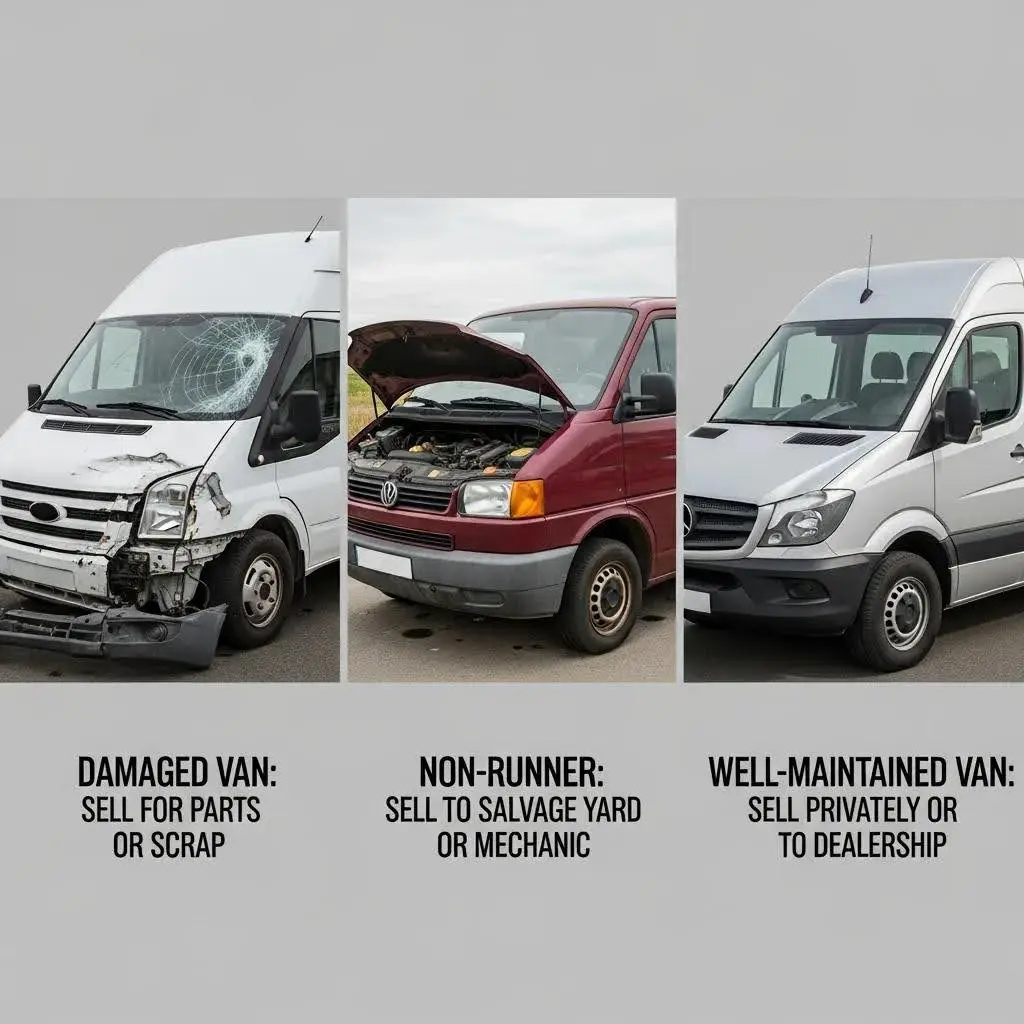
Different van conditions call for different selling strategies: good-condition vans can benefit most from private sale listings in active markets, while damaged or non-runner vans are typically best routed to instant buyers or specialist recyclers for rapid disposal.
Motorhomes and trucks have distinct buyer pools and may require specialist platforms or dedicated instant-buyer services that accept larger commercial vehicles. The guiding principle is to match the selling channel to the vehicle’s condition and the seller’s priorities for speed, net proceeds and effort.
The quick-reference table below matches each condition to a recommended selling route and typical timeframe or value expectation.
| Condition | Selling Option | Typical Timeframe / Expected Value |
|---|---|---|
| Damaged van | Instant buyer or specialist repair-and-resale | Days; a lower headline price but fast disposal |
| Non-runner | Instant buyer with collection | 24–72 hours to quote; collection arranged; reduced price |
| Motorhome | Specialist listings or instant buyer trade | Weeks for private sale; or fast sale to buyer accepting any condition |
| MOT failure | Instant buyer or repair then sell privately | Instant buyer for speed; repair then sell privately for higher net if cost-effective |
Selling a Damaged Van Quickly and Easily
Document the damage with clear photos and an honest description before seeking valuations, because accurate reporting improves the quality of instant quotes and helps prevent later disputes.
For many sellers, instant buyers provide the quickest route: they accept damaged vans, offer free valuations and free collection, and pay on collection, which avoids repair bills and weeks of advertising.
If repair costs are modest relative to the expected private-sale premium, calculate whether investing in repairs and selling privately will yield a higher net return after labour and parts. A short checklist helps sellers prepare for valuation and collection.
- Take multiple clear photos of damage and affected areas.
- Record any fault codes or warning lights and the van’s running status.
- Gather service history, MOT documents and proof of ownership.
Using this checklist streamlines valuations and helps ensure you get an accurate instant quote or private-sale listing.
Fastest Way to Sell a Non-Running Van
Non-runners present obvious challenges for private sale: few buyers will arrange collection or risk towing costs, and adverts attract limited interest. Instant buyers who accept non-runners and provide free collection remove the logistical burden of towing and often offer a guaranteed, quick payment on collection.
When comparing options, account for towing fees, storage costs and the time required to find a private buyer; often the instant buyer’s convenience and removal service outweigh a slightly higher private-sale price. Complete documentation and clear reporting of non-running status help buyers produce accurate offers and plan collection.
| Condition | Selling Option | Typical Logistics |
|---|---|---|
| Non-runner | Instant buyer with collection | Buyer arranges free collection and handles towing. |
| Damaged | Instant buyer or trade-in | Valuation reflects repair costs and salvage value. |
| Motorhome | Specialist instant buyer or broker | Collection and heavy-vehicle handling arranged by buyer. |
What Are the Latest UK Van Market Trends and How Do They Affect Your Selling Choice?
In 2024, the used van market shows resilience in many segments, with demand for reliable commercial vehicles sustaining prices even as some new van registrations lag, which affects the relative attractiveness of private sale versus instant disposal.
Higher used-vehicle demand can increase the private-sale premium for certain models and configurations, while regulatory shifts and growing electric van adoption influence buyer pools and depreciation patterns.
Sellers should weigh current demand for their van type, anticipated regulatory impacts and the speed at which electric vehicle acceptance is changing residual values when choosing a sales route.
These market dynamics lead to practical takeaways for sellers deciding between immediate disposal and waiting for a private sale.
Used Van Market vs New Van Sales
Used van demand in 2024 remains strong for dependable diesel and well-specified vans, but new van registrations have softened in some segments, which tends to support used prices for popular models.
This dynamic means that if your van matches high-demand specifications, a private sale might realise a good premium, provided you can wait and manage the sale process.
Conversely, if your model is less sought-after or in poor condition, instant buyers provide certainty and rapid disposal that often make more sense than lengthy private listings. Sellers should evaluate local demand and comparable listings when deciding which channel to use.
Impact of Regulations and Electric Van Adoption on Selling
Regulatory changes affecting taxation, emissions zones and Vehicle Excise Duty influence buyer preferences and residual values, especially for older diesel vans in cities with strict low-emission zones.
Meanwhile, accelerating electric van adoption shifts buyer pools and can depress values for some older combustion-engine vans while boosting demand for late-model or high-spec vehicles with low running costs.
When selling, consider whether upcoming regulations or local emissions policies will narrow your pool of private buyers, in those cases, instant buyers who accept any condition may offer the speed and certainty you need to avoid future depreciation risk.
With the market context in mind, the final section addresses common seller questions and practical timelines.
Frequently Asked Questions
Sellers frequently ask whether a private sale or an instant buyer will deliver the best price, how fast an instant buyer can complete the sale, and whether instant buyers will accept damaged or MOT-failure vans.
The answers depend on your priorities: choose private sale when you can wait and expect a higher net after costs; choose an instant buyer when speed, certainty and minimal effort are paramount. Instant buyers typically turn quotes around quickly and arrange collections to match seller availability, making them ideal for urgent disposals.
Should I Sell My Van Privately or to a Business for the Best Price?
If you can invest time, prepare the van well and target the right buyer market, selling privately often achieves the best headline price; however, factor in ad fees, repair costs and the value of your time before concluding it is superior.
For vans with widespread demand and full documentation, the private route can be worth the effort, whereas for older, damaged or specialist vehicles with a limited buyer pool, a business sale to an instant buyer can produce a better net outcome when time and hassle are considered. Use a net-of-costs comparison to make the final choice.
How Fast Can I Sell My Van Using an Instant Van Buyer Service?
Instant buyer timelines vary by location and vehicle condition, but many services provide an online quote within minutes and can schedule free collection within 24–72 hours or up to a week depending on logistics.
Payment is typically immediate at collection, either as instant cash payment or by direct bank transfer, delivering rapid access to funds compared with the uncertain timeline of private sales. Factors such as remote location, vehicle size and paperwork readiness may extend the collection window slightly, so confirm expected timings when accepting an offer.
Will Instant Van Buyers Accept My Damaged or MOT Failure Van?
Yes, instant buyers commonly accept vehicles in poor condition, including MOT failures, body-damaged vans and non-runners, providing sellers with a prompt route to cash and removal services.
Valuations for such vans reflect repair and disposal costs, so offers will typically be lower than for clean, roadworthy vans, but the trade-off is speed and removal without additional expenses. If you have a damaged or non-running vehicle, obtaining an instant quote and comparing it to scrap or repair-plus-sale options usually reveals the fastest, lowest-effort path to disposal.
- Decide your priority: Maximum price or the fastest possible sale.
- Get comparable quotes: at least one private-sale estimate and one instant buyer quote.
- Calculate net outcome: Subtract advertising, repair and holding costs so you can compare fairly.
These steps provide a simple decision framework so you can choose the most practical selling route for your van.